Hands get treated as an afterthought, which is strange when you consider how much more they go through than faces do. Water, soap, weather, friction, over and over all day, on skin that has fewer oil glands to start with across the backs and knuckles.
That difference is why hand cream is built differently. It’s also worth looking at how one is built, because ingredient lists tell you more than the marketing usually does, provided you know how to read the order.
The order is the information
Ingredient lists are printed in descending order of how much is in the bottle, down to about the one percent mark, after which the order stops meaning much. So the first several entries are most of what you’re putting on your skin, and anything near the bottom is there in small amounts.
This is worth knowing mainly because it lets you read any label with a clearer eye. A botanical named in big type on the front, then sitting near the bottom of the list on the back, is doing less work than the front of the box suggests.
Here’s the Nourish Hand Cream’s list, unedited:
Aqua, Stearic Acid, Helianthus Annuus (Sunflower) Seed Oil, Caprylic/Capric Triglyceride, Cetearyl Alcohol, Polysorbate 60, Vitis Vinifera (Grape) Seed Oil, Simmondsia Chinensis (Jojoba) Seed Oil, Persea Gratissima (Avocado) Oil, Glyceryl Stearate, Cetyl Alcohol, Glycerin, Fragrance, Cyclomethicone, Tocopheryl Acetate, Butyrospermum Parkii (Shea) Butter, Pentaerythrityl Tetra-Di-T-Butyl Hydroxyhydrocinnamate, Aloe Barbadensis Leaf Juice, Xanthan Gum, Sodium Gluconate, Allantoin.
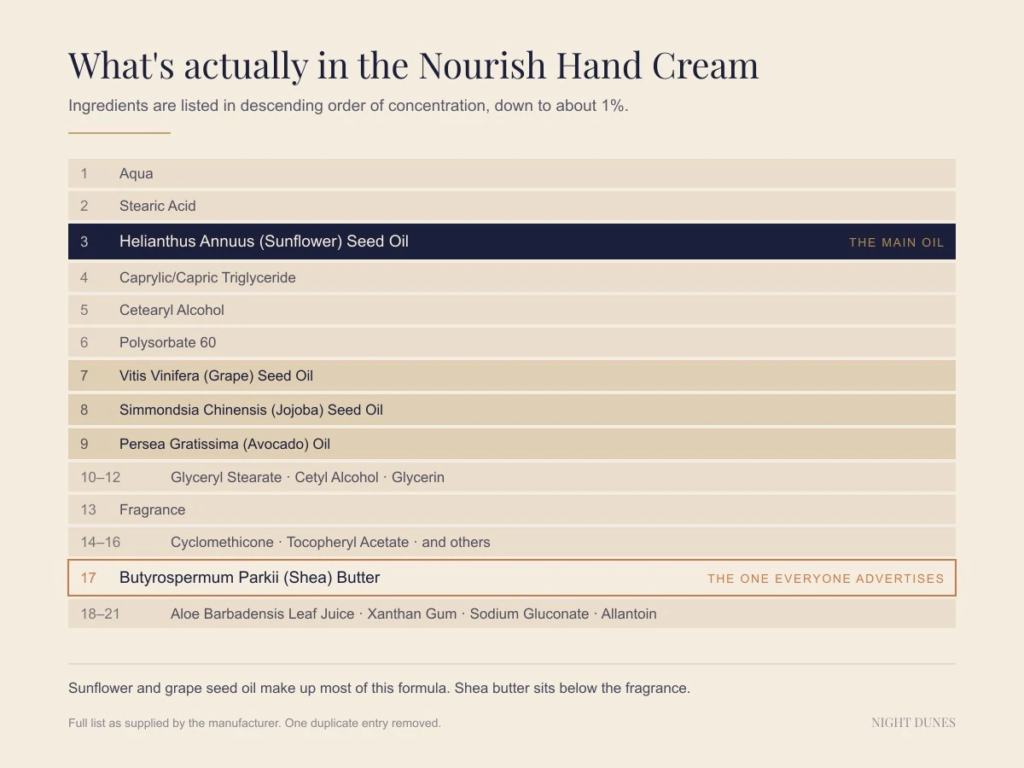
Water first, which is true of nearly every cream. Then stearic acid, a fatty acid that does the structural work of holding an emulsion together. Then the oils.
Sunflower is the one doing the heavy lifting
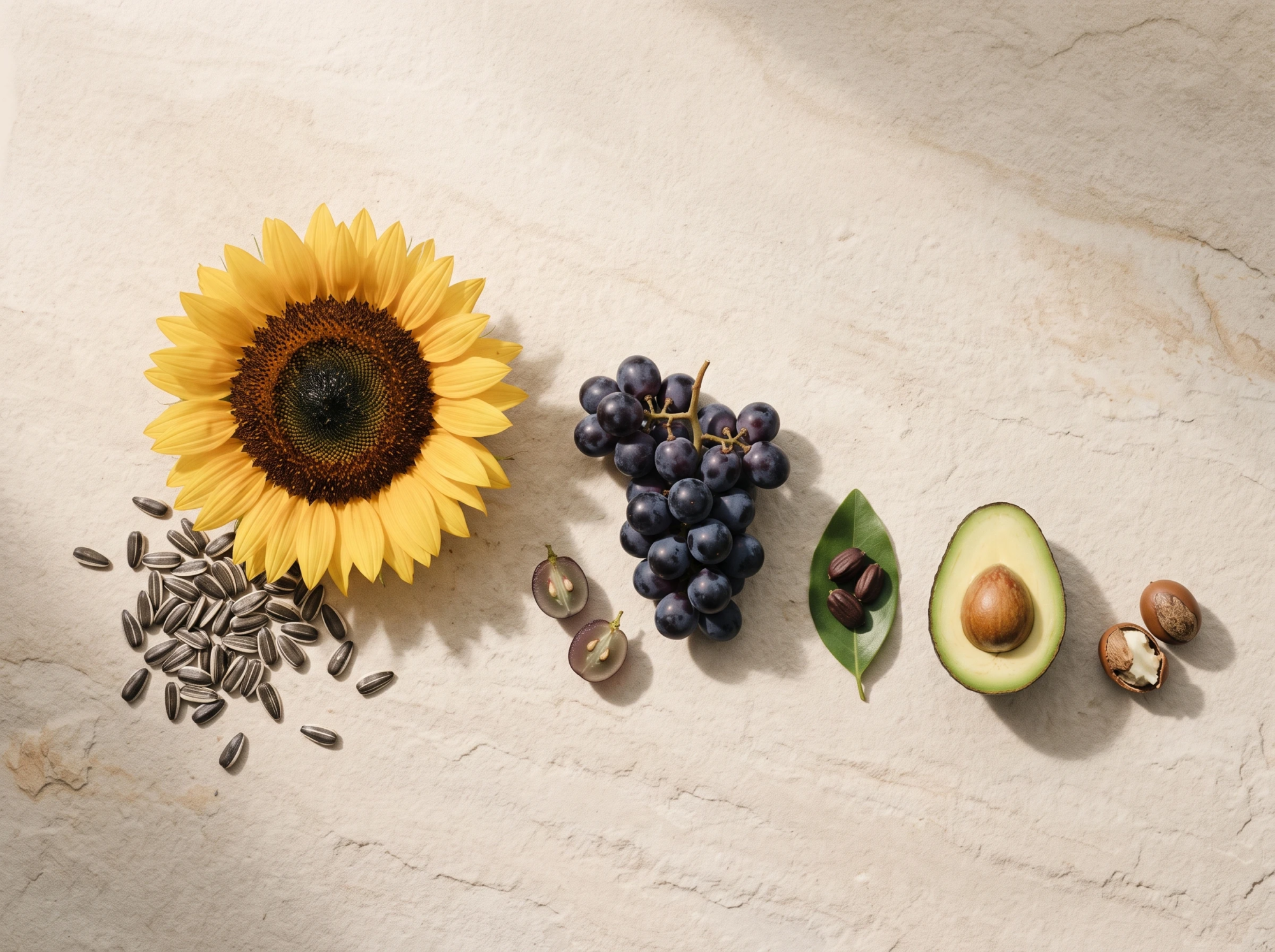
Sunflower seed oil sits third, above every other botanical in the formula, and it’s the ingredient with the most interesting evidence behind it.
Sunflower oil is high in linoleic acid, generally in the range of 48 to 74 percent depending on the variety. Linoleic acid matters to skin specifically because it’s a building block of ceramide-1 linoleate, one of the lipids that holds the outer layer of skin together. An oil supplying it isn’t just sitting on the surface.
There’s decent clinical work here too. A randomised forearm study found sunflower seed oil preserved the integrity of the outer skin layer and improved hydration without causing redness, while olive oil, tested alongside it, measurably weakened the barrier. That result surprised a lot of people who assumed all plant oils were roughly interchangeable.
Grape seed oil comes next among the botanicals, at seventh. It’s also high in linoleic acid, light in texture, and rated very low for pore-clogging. Then jojoba at eighth, which isn’t technically an oil at all but a liquid wax ester, structurally close to the wax esters in human sebum, which is why it absorbs the way it does. Then avocado at ninth, contributing fatty acids and vitamin E.
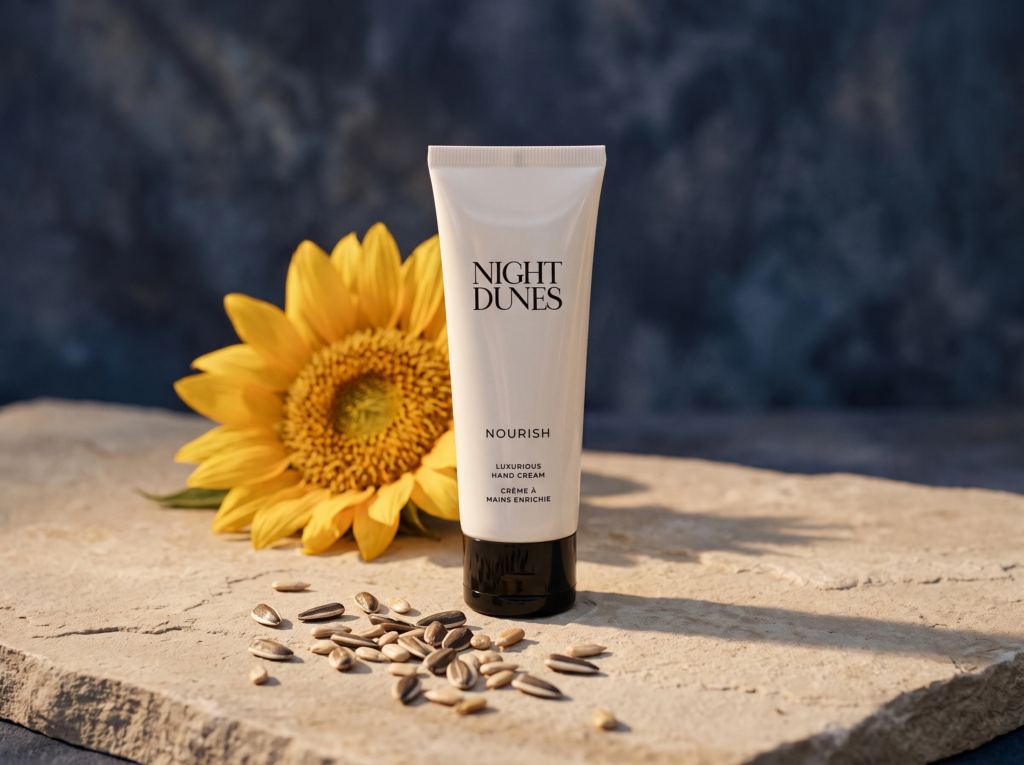
About the shea
Shea butter is in this formula, further down the list, alongside the vitamin E.
Shea is the ingredient hand creams tend to advertise, so it’s worth being clear about what’s actually doing the work here: this is a formula built on sunflower and grape seed oil, with shea in a supporting role.
That’s a good thing rather than a compromise. Sunflower has stronger clinical evidence behind it than shea does, and it’s the ingredient we’d have chosen to lead with anyway.
Further down there’s aloe leaf juice and allantoin, both long-standing inclusions in products meant to feel comfortable on skin, and tocopheryl acetate, a stable form of vitamin E.
One thing to flag
This formula contains fragrance. It’s the only product in the launch collection where that’s the case.
Fragrance in cosmetics is common and legal and most people have no issue with it. It’s also one of the more frequent causes of contact irritation, so if you react to scented products, this is the one in the collection to approach carefully, and worth a patch test on the inside of your wrist first.
Three words worth separating
A humectant attracts water. Glycerin, in this formula, sits twelfth.
An emollient fills the gaps between skin cells and makes skin feel smooth rather than rough. Most of this cream’s oils are doing that.
An occlusive forms a layer that slows water leaving. Shea does this, and so does petrolatum, which does it better than almost anything and feels precisely like what it is.
Hands need the occlusive and emollient parts more than faces do, simply because they’re stripped more often.
When to put it on
After washing, while hands are still slightly damp, so there’s water at the surface for the oils to help hold in place.
The other honest answer is more often than you’re doing now, and particularly last thing at night, when your hands aren’t about to be washed again for several hours.
In the collection: Nourish Hand Cream, 120 ml.
Night Dunes products are cosmetics, formulated to condition and hydrate skin and improve how it looks and feels. Nothing here is medical advice and no product is intended to diagnose or treat any condition. Cracked or broken skin on the hands needs a professional's opinion, not a cosmetic.